
I have spent 20 years in the gap between “we have product-market fit” and “we have a scalable business.”
The Operator’s Story
I became an operator by building companies from zero and, later, stepping into businesses when what had worked before was no longer enough. Sometimes the challenge was growth. Sometimes, performance had deteriorated. Sometimes the technology was strong, but turning it into commercial results was taking too long. And sometimes the immediate problem looked obvious—cash, margins, execution, capacity—but the real cause was somewhere else. Over time, I learned not to accept the visible problem too quickly.
I also learned what it means to be the person ultimately responsible for the outcome. I’ve been a founder raising capital, building a team, and making payroll; a CEO responsible for the entire P&L; and a COO accountable for turning strategy into execution. I’ve had employees depending on my decisions, customers expecting us to deliver, investors and boards asking difficult questions, and situations where no one else could make the call.
That experience matters to how I work with founders and CEOs today. Not because their situation is the same as mine was—it rarely is—but because I understand the weight of being the person at the center of the business. I like entering at moments when the CEO could use another experienced operator beside them: someone who listens and understands first, then digs into the problem with them, challenges assumptions when needed, takes real ownership when required, and helps turn a complicated situation into decisions the organization can execute.
The Visible Problem Is Rarely the Whole Problem
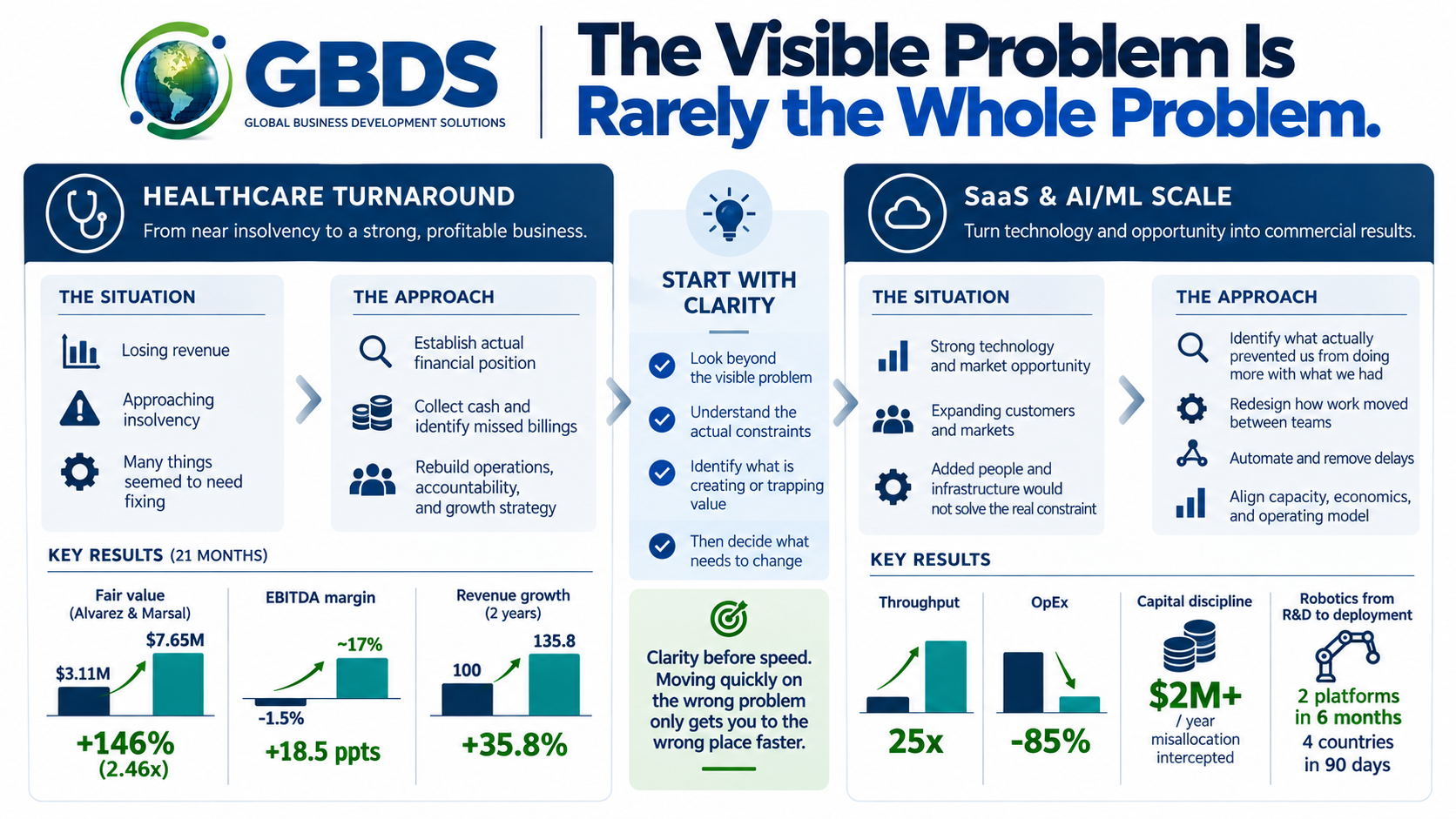
One experience that shaped this approach came when I stepped into a healthcare company as Interim CEO. The business had been losing revenue for an extended period and was approaching insolvency. Plenty of things seemed to need fixing, but we didn’t have the luxury of attacking everything at once.
In the first 48 hours, the questions were much more basic: What is our actual financial position? What cash can we collect? What have we failed to bill? And how much time do we really have?
I worked directly with customers to accelerate payments while we identified missed billings and collection problems and established what was actually happening financially. Only then did we begin rebuilding the business—how services were delivered, billed, coded, measured, and managed; where accountability sat; how decisions were made; and eventually where new growth could come from. By the end of the 21-month mandate, EBITDA had moved from negative to strongly positive, and an independent third party confirmed the business’s value had increased by about 2.5x during my tenure.
The results mattered, but the lesson mattered more: when a business is under pressure, speed matters, but clarity comes before speed. Moving quickly on the wrong problem only gets you to the wrong place faster.
I Start With the Constraint, not with a Prescribed Solution
When I enter a company, I don’t assume it needs more process, another executive, a reorganization, new KPIs, more automation, or another AI initiative. It may need some of those things, but starting with the solution is dangerous because the problem the CEO is experiencing may not be the problem the company actually has.
A cash problem may have started months earlier with pricing, billing, capacity, or a decision to scale before the economics were proven. Slow execution may be a process problem or unclear decision rights. A commercialization problem may look like an R&D problem when the constraint is actually customer validation, cross-functional coordination, or deployment. And a founder bottleneck isn’t necessarily solved by telling the founder to delegate if nobody has established who should make which decisions and what information they need to make them.
So I start with the business: Where is value being created? Where does work stop? Where does cash get trapped? Which decisions keep coming back to the CEO? What is consuming capital without producing enough return? What assumptions are we treating as facts? What does the customer actually need? And what are we still doing, because that is simply how the company learned to operate?
Experience Has Also Changed My Mind
Twenty-plus years of operating companies should leave you with more than success stories. It should leave you with things you would do differently.
One of mine came from a board I helped build. We brought together capable people with relevant experience, and on paper, it looked strong. I expected that putting good people around the table would lead to better decisions. It didn’t work that way. The structure itself created problems: status affected discussion, strong personalities made constructive challenge harder, and more expertise did not automatically produce better governance. Since then, I’ve approached board design and composition very differently.
The broader lesson has stayed with me: a collection of capable people is not the same thing as a capable organization. Hiring another executive doesn’t automatically remove a founder bottleneck. Adding engineers doesn’t necessarily accelerate development. Adding salespeople doesn’t fix weak retention. Adding software doesn’t repair a broken workflow. And adding AI to a poorly designed process may simply automate the inefficiency.
People matter enormously, but so do structure, incentives, information, decision rights, and the way work moves through the organization. Part of being an experienced operator is knowing how those pieces work together—and which ones need to change.
Years later, I encountered a very different version of the same challenge as COO of a venture-backed SaaS & AI/ML company. This time, the problem wasn’t survival. It was scale. The company had strong technology and significant opportunities, with customers, markets, and technical capabilities expanding. The obvious response would have been to keep adding people and infrastructure behind that growth. Instead, I kept coming back to different questions: What is actually preventing us from doing more with what we already have? And how can we scale to absorb the growth we want to achieve?
That question took us across the business. We looked at how work moved between teams, where handoffs created delays, what should be automated, where people spent time that wasn’t creating enough value, how capacity related to the economics, and where the operating model itself limited what the technology could accomplish. Throughput, processing speed, and cost improved substantially, but those were outcomes of changing how the business worked, not the starting objective.
The same approach changed how we thought about R&D and commercialization. Rather than accepting long development cycles as an unavoidable consequence of sophisticated technology, we looked at the entire path from customer need to commercial deployment: what actually needed to be built, what we could reuse, what customers needed to validate, where decisions were slowing the work, and how the technical and commercial pieces needed to come together. Two robotic platforms went from concept to first deployment in about six months, compared with previous development cycles that had taken significantly longer.
The technology mattered, but so did everything around the technology that allowed it to become a commercial product. That distinction has become central to the way I operate.
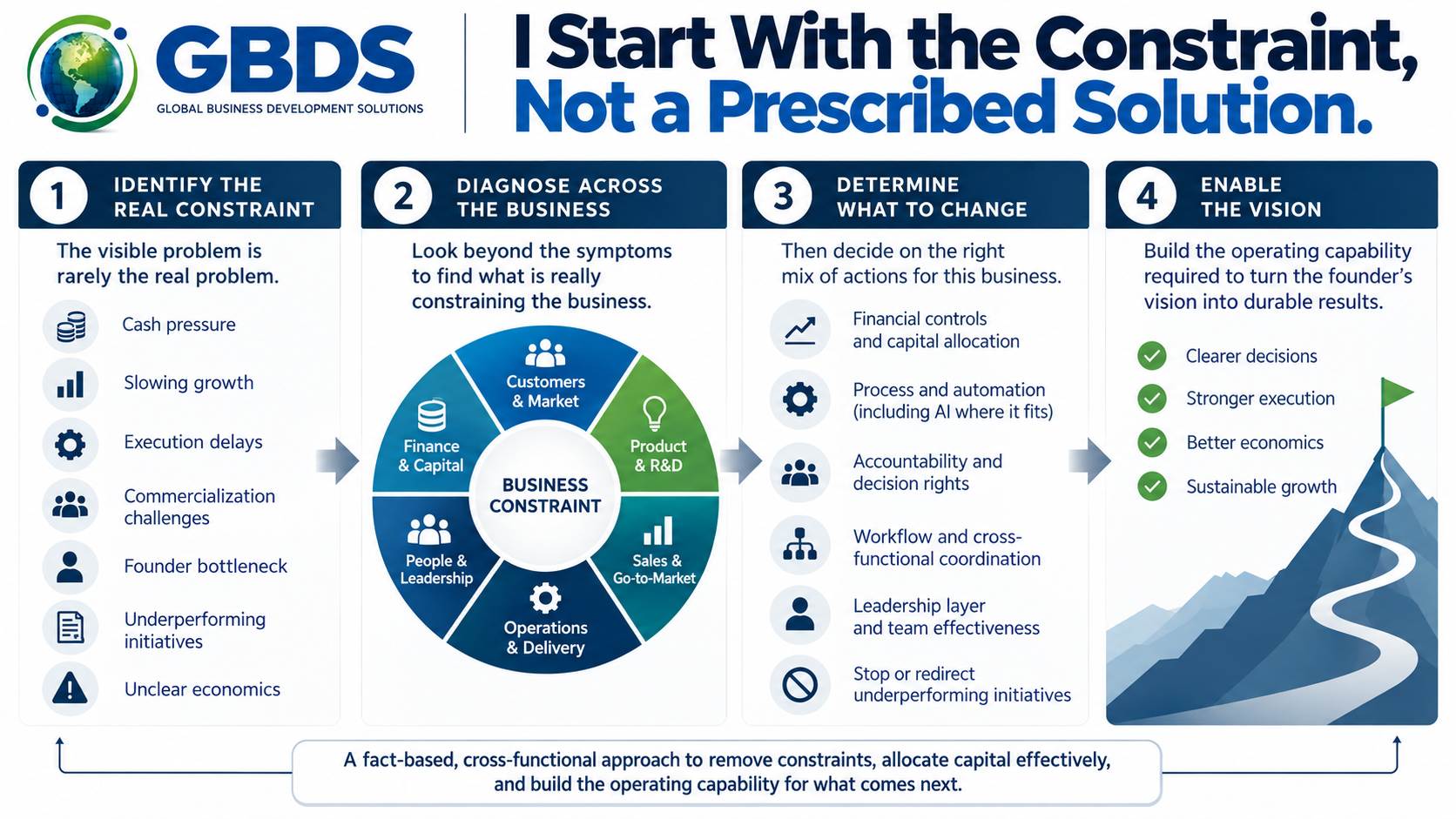
Only then do I decide what needs to change. Sometimes it is financial controls or automation. Sometimes it is clearer accountability and decision rights, redesigning a workflow, changing how teams interact, or strengthening the leadership layer. Usually, the answer crosses more than one function.
And sometimes the right decision is to stop something. I’ve challenged initiatives with strong internal sponsorship, re-underwritten cost assumptions, and proposed redirecting capital toward better uses when the economics no longer justified the original plan. Those conversations aren’t always comfortable, but my job isn’t to protect an initiative because the organization has already invested time, money, or credibility in it. It is to make the facts, economics, and trade-offs clear enough that we can make the right decision for the business.
That doesn’t mean replacing the founder’s vision. On the contrary, it means helping establish what has to be true operationally for that vision to work.
A Little More About Me
I grew up in Lima, Peru, built much of my career in the United States, and now work across the U.S. and Europe. I’m a dual U.S./EU citizen, bilingual in English and Spanish. I’m also the father of four children, which has given me another perspective on leadership, negotiation, and the limits of believing you can control every outcome.
My formal education includes a year-long Chief Operating Officer Program from MIT xPRO, including specialization courses in Leadership in Designing and Building AI Solutions and Internet of Things Design & Applications; an MBA from Seattle University’s Albers School of Business and Economics; and a B.S. in Industrial Engineering from Universidad de Lima in Peru.
My governance experience spans more than 20 years across for-profit and nonprofit boards, including approximately a decade with Antioch University, where I served as Board Member, Board Chair, and Trustee. I have also served as a Board Observer and advisory board member, participated in angel investing, and led venture due diligence.
Contact us
Whether you are a founder hitting an operational wall, a VC looking for portfolio support, or a PE firm that needs embedded operational leadership for an acquisition, I am happy to have a conversation.
Book a Discovery Call
30 minutes. No pitch. Just a conversation about where your operations are and where they need to be.