

Everyone Blames the Cash. The Cash Was the Last Domino.
“We ran out of cash.”
That’s how a lot of startup post-mortems end.
But running out of cash is often the last domino—not the first.
The decisions that actually put the company in trouble may have happened 6, 12, or 18 months earlier: scaling customer acquisition before retention was proven, entering another market before the economics worked, adding headcount ahead of repeatable demand, or committing capital against assumptions that hadn’t been sufficiently tested.
The research is striking. A recent analysis of 431 VC-backed companies that shut down found that running out of capital was a factor in 70% of the failures. But the underlying problems started earlier.
In this article, I break down the four-step operating approach I use to diagnose the problem, identify the real constraint, and determine what—if anything—the company should scale next.
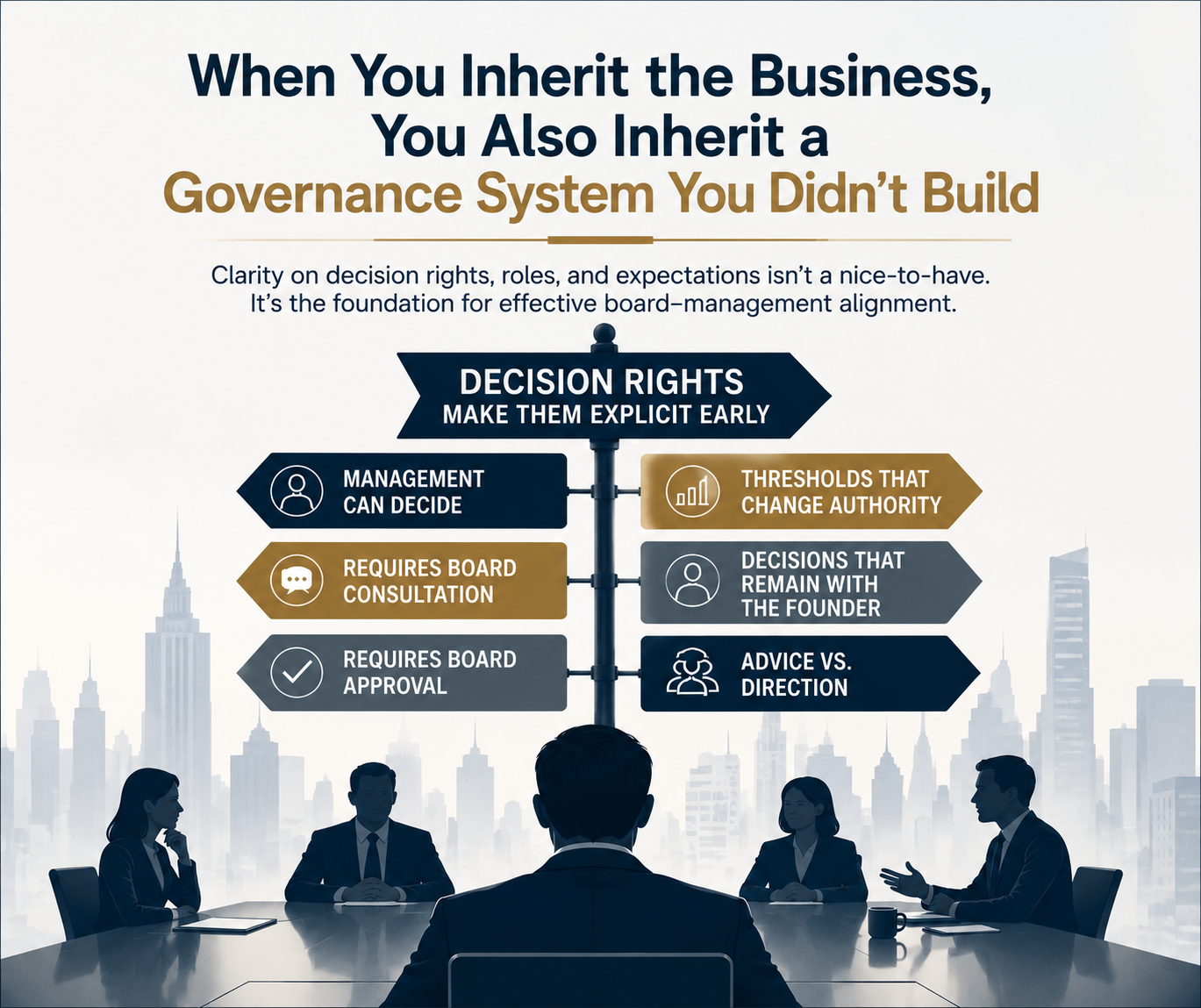
When You Inherit the Business, You Also Inherit a Governance System You Didn't Build.
When an external COO, interim CEO, or operating executive steps into a company, they inherit the strategy, expectations, relationships, and problems—but not the history that created them.
That makes governance ambiguity more than a board-management issue; under an urgent mandate, it can quickly become an execution issue. In this article, I look at why decision rights, founder involvement, board expectations, and communication thresholds need to be made explicit early—and why waiting for a crisis to discover how the governance actually works is already too late.

The CEO–COO Relationship Isn’t a Division of Labor. It’s a Decision-Making Partnership.
Most companies define the CEO–COO relationship by dividing responsibilities. Role clarity matters, but it is not enough. The stronger model is a decision-making partnership where strategic ambition and operational evidence can challenge each other without the relationship breaking. When that works, the COO is not simply executing strategy downstream—they are helping test the assumptions that determine whether the strategy will actually create value.