
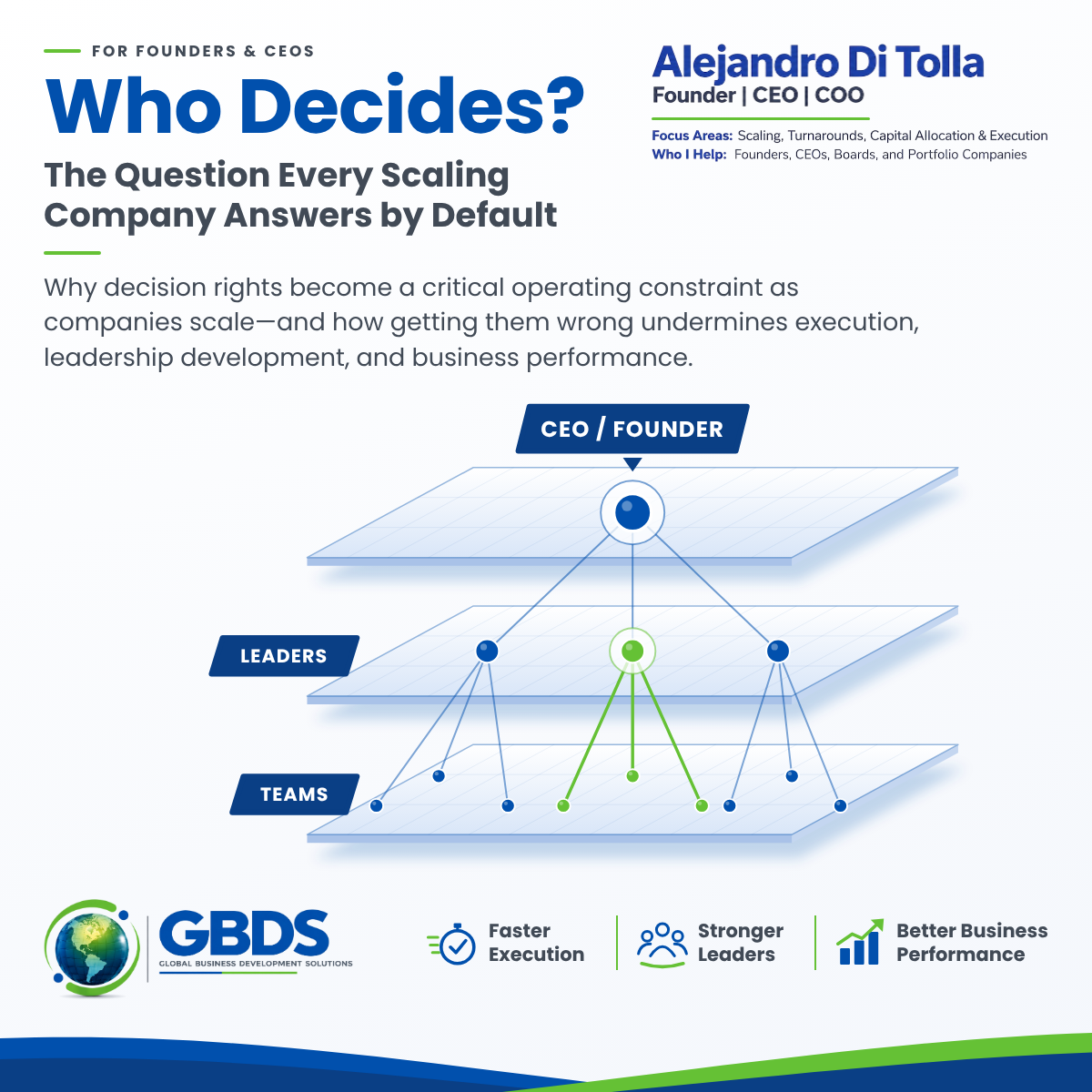
Who Decides? The Question Every Scaling Company Answers by Default
A company can have capable leaders, adequate resources, and strong market opportunities—and still struggle to scale.
One often-overlooked reason is that the organization has outgrown its decision-making process.
As businesses grow, leadership delegates responsibilities, but decision-making authority often remains concentrated at the top. Managers or leads become accountable for results they cannot fully control, routine decisions require unnecessary approvals, and executives spend time on issues that should be resolved elsewhere.
I’ve encountered these challenges firsthand, as a founder and an operating executive.
In my latest article, “Who Decides? The Question Every Scaling Company Answers by Default,” I examine the research, the operating consequences of poorly defined decision rights, and practical approaches to developing leaders who can exercise sound judgment and make decisions within clear boundaries.
Scaling requires more than delegating responsibilities. It requires building an organization that can make and execute sound decisions without everything flowing back to the top.
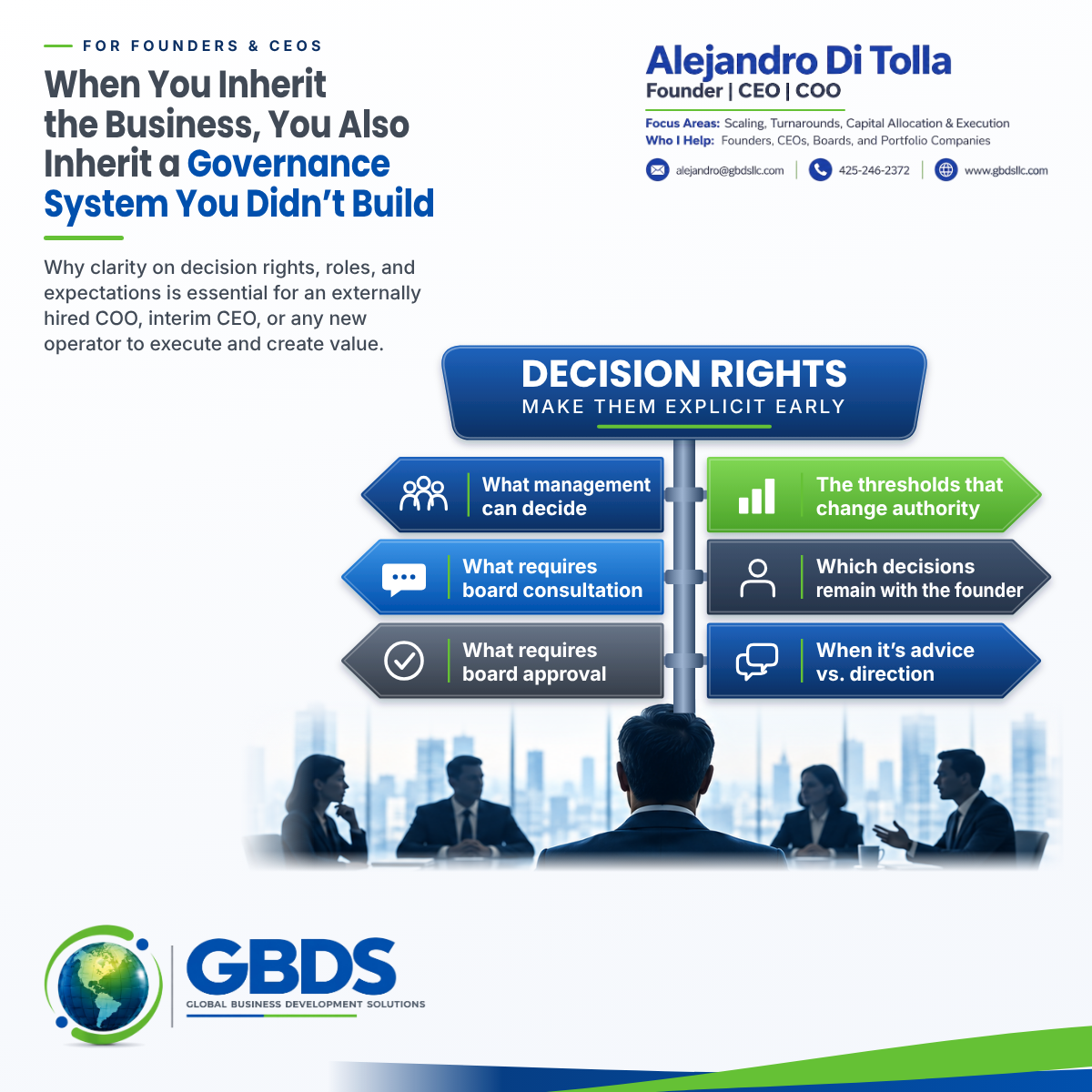
When You Inherit the Business, You Also Inherit a Governance System You Didn't Build.
When an external COO, interim CEO, or operating executive steps into a company, they inherit the strategy, expectations, relationships, and problems—but not the history that created them.
That makes governance ambiguity more than a board-management issue; under an urgent mandate, it can quickly become an execution issue. In this article, I look at why decision rights, founder involvement, board expectations, and communication thresholds need to be made explicit early—and why waiting for a crisis to discover how the governance actually works is already too late.
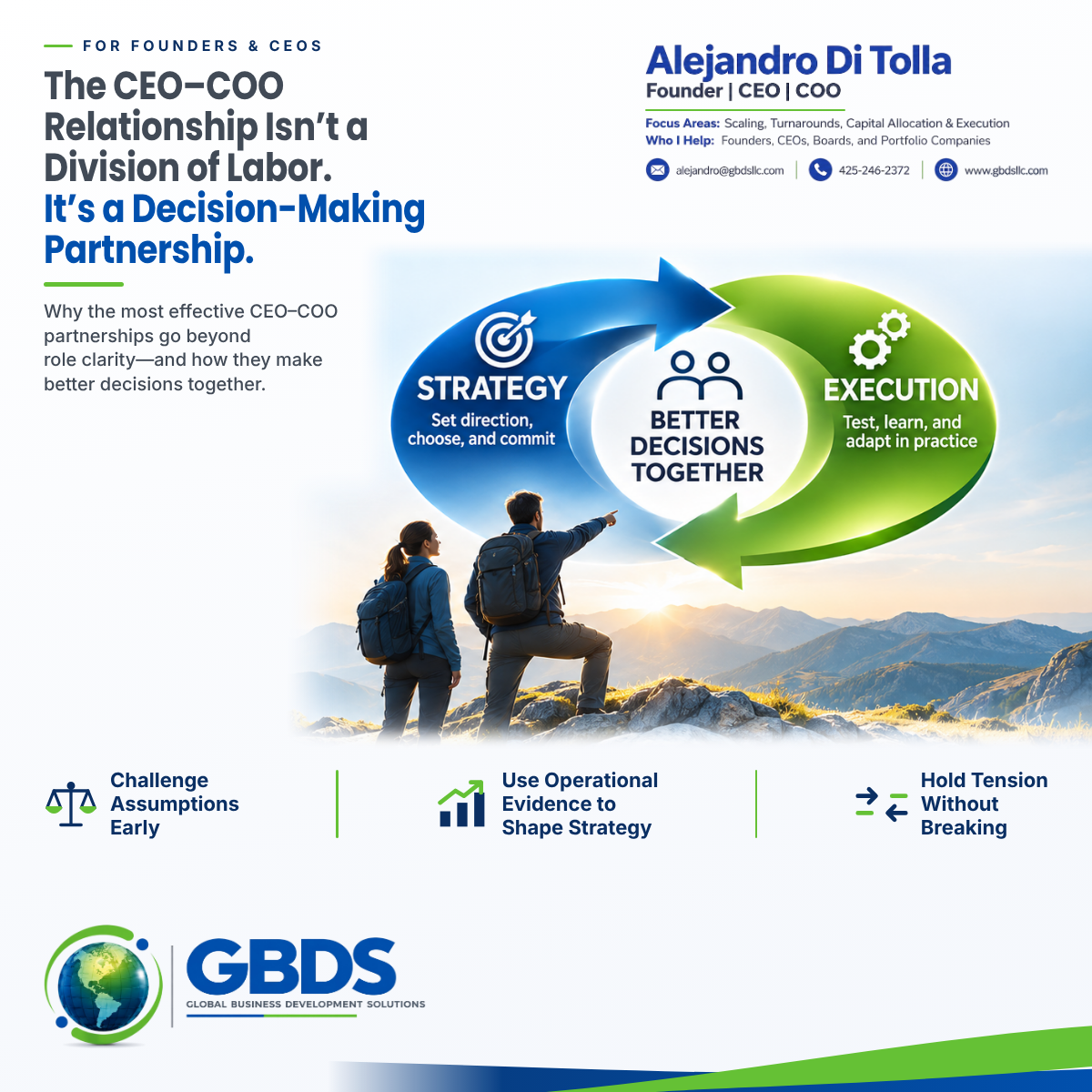
The CEO–COO Relationship Isn’t a Division of Labor. It’s a Decision-Making Partnership.
Most companies define the CEO–COO relationship by dividing responsibilities. Role clarity matters, but it is not enough. The stronger model is a decision-making partnership where strategic ambition and operational evidence can challenge each other without the relationship breaking. When that works, the COO is not simply executing strategy downstream—they are helping test the assumptions that determine whether the strategy will actually create value.