
Operational Results That Speak for Themselves
I measure my work by business outcomes, not activity. Different companies require different solutions, but the standard is the same: understand what is constraining the business, make the necessary decisions, and improve its ability to perform.

Case Study 1: Healthcare Turnaround
Vertical: Healthcare Services
Role: Interim CEO | 21-month turnaround mandate
Challenge: The company had been losing revenue for an extended period and was approaching insolvency. Cash was under pressure, financial visibility was weak, services were going unbilled, collections were slow, and the operating and management systems needed to be rebuilt.
What I Did: Established the financial reality and immediate cash priorities, recovered missed billings, accelerated collections, and then rebuilt core operating disciplines across service delivery, scheduling, coding, billing, financial reporting, performance management, and accountability. Once the business was stabilized, we introduced a new rehabilitation service line and secured support from major insurers.
Result:
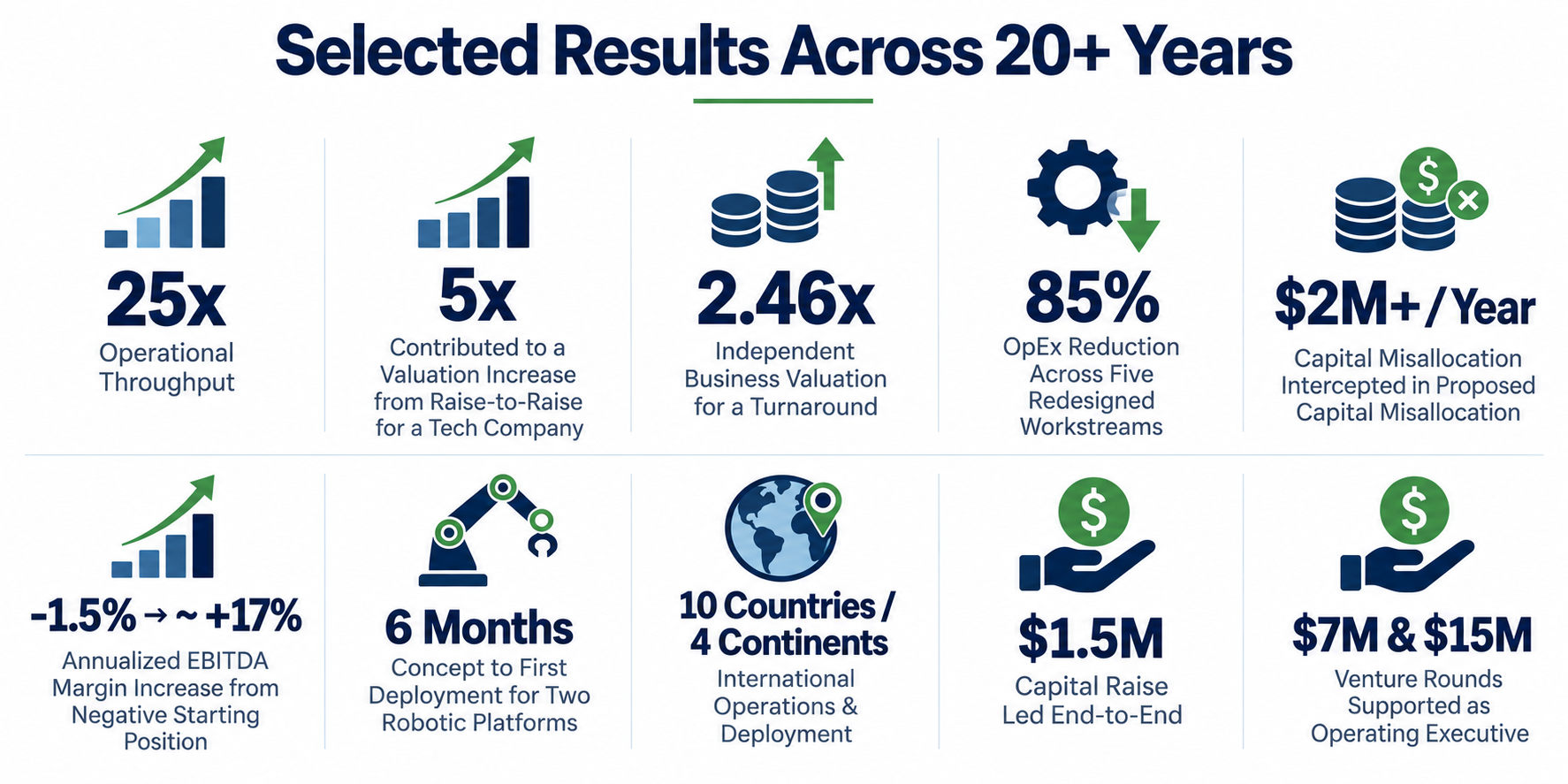
2.46x increase in independently appraised business value: $3.11M → $7.65M
EBITDA: -1.7 → approximately +17% EBITDA margin annualized
Revenue: $3.61M → $4.91M, +35.8%
Cash collections: +218% within 10 months
DSO: reduced approximately 50%
New service line subsequently generated approximately 50% Year-1 revenue growth
Takeaway: The cash crisis was the visible problem. The turnaround required fixing what was producing it—financial controls, revenue capture, operating discipline, accountability, and eventually the company’s ability to grow profitably.
Case Study 2: SaaS & AI/ML — Scaling Operations and Commercialization
Vertical: SaaS & AI/ML
Role: COO | Venture-backed scale-up, Seed through Series B
Challenge: Strong technology and growing commercial opportunity were creating increasing operational complexity. The company needed substantially greater capacity, faster R&D-to-deployment cycles, and international scale without increasing cost and headcount at the same rate.
What I Did: Led the redesign and automation of five cross-functional workstreams, strengthened operating and financial discipline, and worked across engineering, product, operations, and commercial teams to remove constraints between technology development and customer deployment. Co-led development and commercialization of two robotic inspection platforms and built the operating capability for international deployment.
Result:
25x operational throughput
20x processing speed
85% OpEx reduction across five redesigned workstreams
Intercepted a $2M+/year in proposed capital misallocation, validated the economics with technical leaders, and developed a lower-cost architecture capable of the required outcome at a fraction of the cost
Two robotic platforms moved from concept to first deployment in approximately 6 months
Platforms deployed across 4 countries within 90 days
Operating and commercial activity expanded across 10 countries / 4 continents
Operating capacity built to support approximately $7M+ ARR without proportional headcount or CapEx growth
Contributed to a 5x+ increase in company valuation across financing rounds
Key Decision: Challenged a proposed non-adjacent vertical expansion and made the data-backed case for a more attractive adjacent market. Management ultimately chose to pursue both. Once the decision was made, I aligned behind it and built the operating capabilities required to execute both strategies. Over time, the non-adjacent market produced few profitable projects, while the adjacent vertical became the company’s biggest revenue opportunity.
Takeaway: Scaling isn’t simply adding capacity behind growth. The better question is what prevents the business from producing more value with the people, technology, and capital it already has—and where additional investment will actually create a return.
Case Study 3: Building a Regulated Venture From Zero
Vertical: Regulated Agribusiness
Role: Founder & CEO
Challenge: Build a company from the ground up in an emerging regulated market—raising capital, navigating permitting and regulation, building the organization and commercial model, and reaching revenue before the runway became the constraint.
What I Did: Built the business and operating infrastructure from zero, led a $1.5M capital raise end-to-end, developed institutional and regulatory relationships, built the team and operating model, and developed a B2B revenue channel while much of the market remained focused on B2C.
Result:
$1.5M capital raised
Built the organization and operating infrastructure from zero
Reached revenue within 18 months
Achieved approximately 150% of the revenue plan
Helped pass two bills in Washington State supporting the industry
Takeaway: In a new venture, operating discipline begins before there are operations to optimize. Capital, regulation, commercial strategy, organization, and execution have to develop together.
Operating Judgment: Knowing When to Challenge the Plan and When to Align and Build it
Operating leadership isn’t only about making an agreed plan happen. Sometimes the greater value comes from recognizing when the plan itself needs to be challenged.
Re-underwrote a major technology investment. Cost and customer-preference data did not support the proposed approach. My teams and I developed a substantially lower-cost alternative and presented the economics behind it. The data ultimately supported the alternative.
Challenged non-adjacent vertical expansion. I presented the case for a more economically attractive adjacent vertical instead. Both were ultimately pursued. The non-adjacent market produced few profitable projects; the adjacent vertical became the company’s biggest revenue opportunity
The point isn’t being willing to say no. It is knowing when the evidence requires you to challenge an assumption—and bringing a viable alternative when you do. And once a decision is made, align behind it and build the operating capabilities required to execute both strategies.