
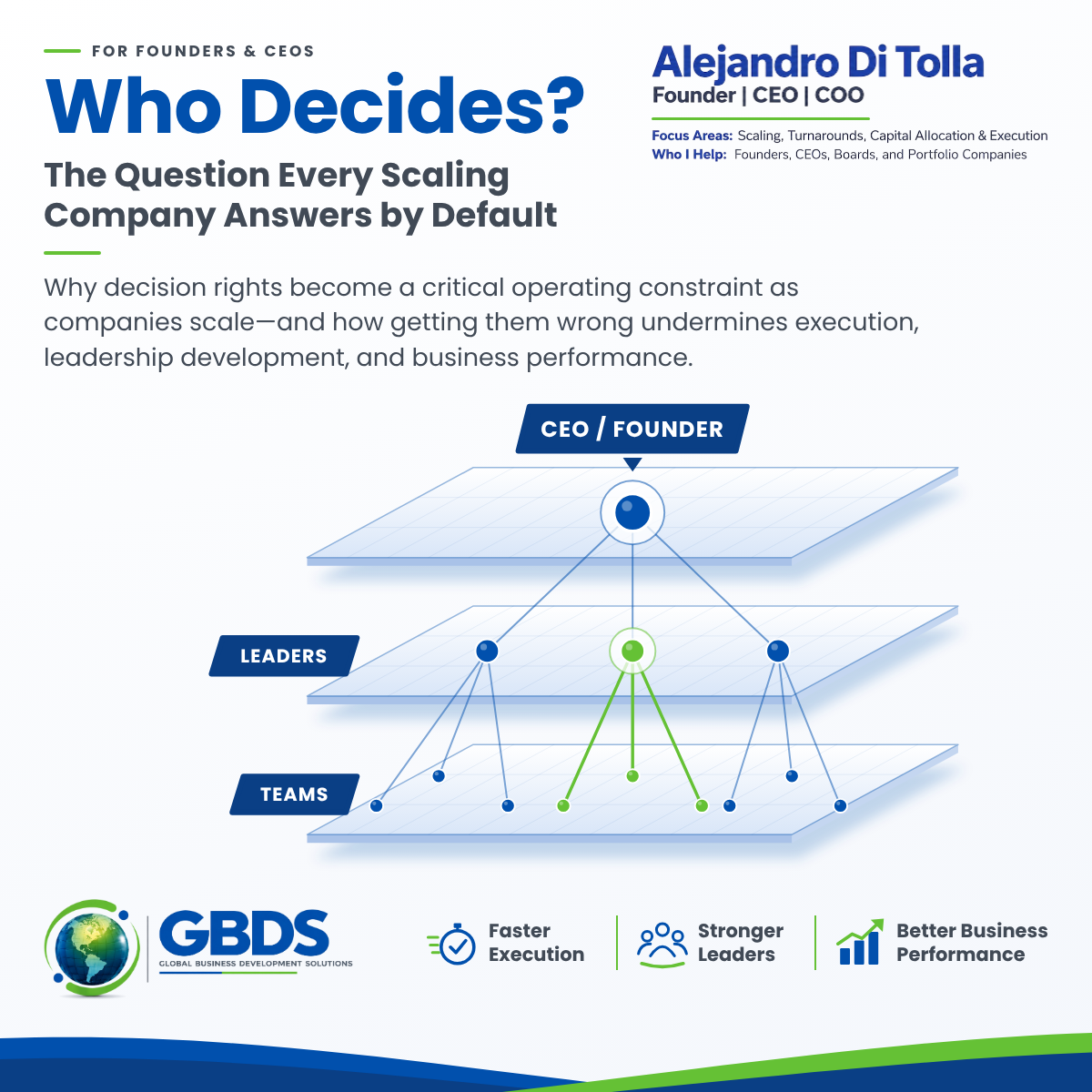
Who Decides? The Question Every Scaling Company Answers by Default
A company can have capable leaders, adequate resources, and strong market opportunities—and still struggle to scale.
One often-overlooked reason is that the organization has outgrown its decision-making process.
As businesses grow, leadership delegates responsibilities, but decision-making authority often remains concentrated at the top. Managers or leads become accountable for results they cannot fully control, routine decisions require unnecessary approvals, and executives spend time on issues that should be resolved elsewhere.
I’ve encountered these challenges firsthand, as a founder and an operating executive.
In my latest article, “Who Decides? The Question Every Scaling Company Answers by Default,” I examine the research, the operating consequences of poorly defined decision rights, and practical approaches to developing leaders who can exercise sound judgment and make decisions within clear boundaries.
Scaling requires more than delegating responsibilities. It requires building an organization that can make and execute sound decisions without everything flowing back to the top.
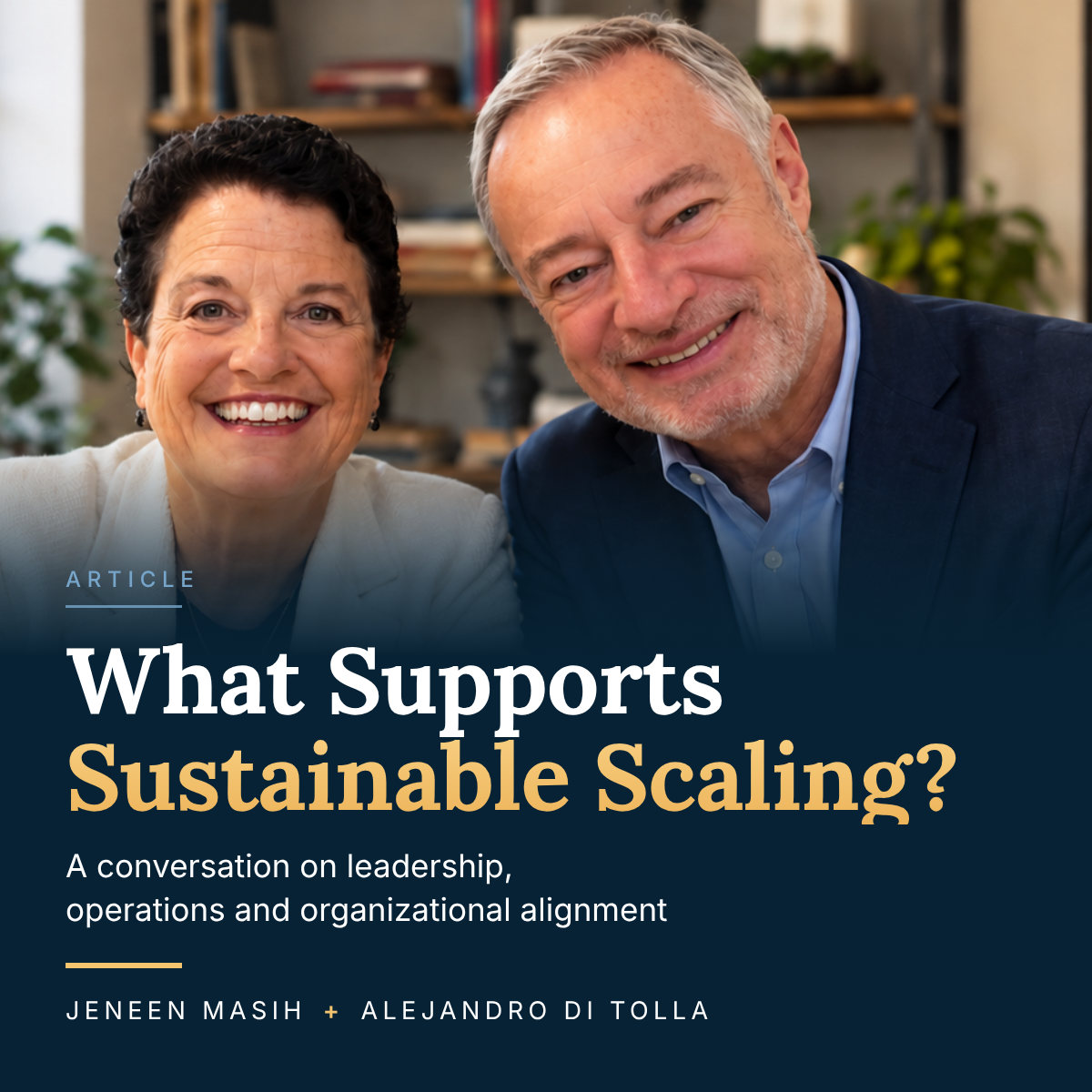
What Supports Sustainable Scaling in Today’s Dynamic Business Environment?
As organizations grow, complexity often increases faster than the systems designed to manage it. What looks like a sales problem, an execution problem, or a leadership problem may actually be a deeper issue of organizational alignment. In this conversation, Jeneen Masih and Alejandro Di Tolla explore how leadership, operations, communication, trust, and decision-making must work together to build an organization capable of scaling sustainably.
That stays close to what the article actually delivers rather than turning the excerpt into promotional copy. The article specifically argues that different functions often see legitimate but incomplete parts of the problem, and that sustainable scale requires a more systemic view.